
Lada Egorova
I never read again what I wrote before, not until I have completed my first draft

Tell us about yourself and your most current project/s?
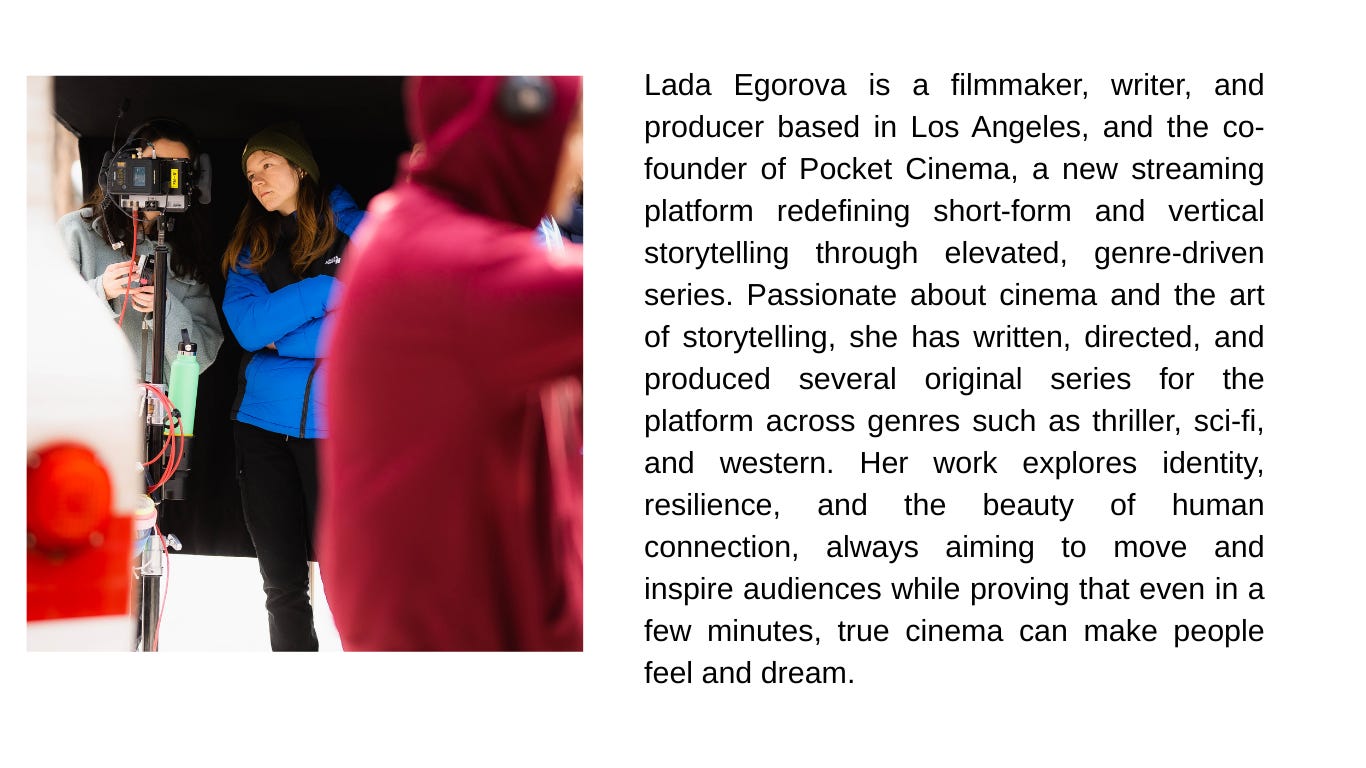
I’m a Russian-French writer, director and producer based in Los Angeles. I have written and directed a dozen short films, my latest one was selected in a screenwriting residency in France and got a film production grant. I also created 2 TV pilots, one got picked up for distribution. This year I have written, directed and coproduced 3 full series, and I am currently in preproduction of three new series for the short series app Pocket Cinema I cofounded, a platform for genre-driven vertical series (but we also do horizontal traditional series) with a focus on elevated storytelling and the support of rising filmmakers. The app will release end of 2025. My latest detective-noir series The Price of Yesterday will be shooting end of this month.
Where did the inspiration/idea come for this project?
Since I became more interested in cinema during my teenage years and when I begun to learn more about film history, I discovered film noir movies and immediately fell in love by the cinematography, the themes, the overall aesthetic of this genre. One of my first short films was a noir film, playing with the codes of the genre and trying to experiment with the lighting and framing. Since then I’ve always wanted make another film noir project but of a bigger size. A couple months ago my cofounder suggested making a detective series for Pocket Cinema. We discussed a few ideas and that’s when I realized this was the perfect time to go back to film noir. We brainstormed a couple of concepts together and worked together on creating a synopsis and at least have the first half thought-of. After that I fully took on the writing of the project and worked on a detailed outline and then writing the script.
What does the writing process look like for you?
I like to follow some steps that help me make progress and head to the right direction. I start brainstorming ideas and at this stage inspiration can really come from anywhere. Sometimes I actually sit and think “okay what story can I tell now?” Other times I’m just living my life when an idea hits me. After that I like to create a logline then a synopsis then a detailed outline. I like to take my time with my outline, to make sure it makes sense to me, the structure works because it will be my guide for writing the script. I also like to create a character sheet for my principal characters and a little description for other characters too. That way I get an idea of who my characters are and I’ll know how they would react, what they would do, how they would speak etc.
After that I like to set deadlines for the screenwriting part. I use my outline as a guide but stay open for in the moment ideas. It happens that my outline changes slightly or I add new scenes because that’s where the story is taking me as I am writing it.
I never read again what I wrote before, not until I have completed my first draft. My goal first is to get through the first draft, without stopping, without having doubts. Once my first draft is done, I put the script away for a couple of weeks to come back to it with fresh eyes. Then begins the rewriting process.
How do you handle writer’s block?
During the writing process of the script I do not have writer’s block because I always refer to my outline to know what I should write next.
However, I do have sometimes writers block during the process of looking for ideas or when making my outline.
I like to write, just the act of writing helps me unlock my brain, write thoughts, images, character lines anything that comes to my mind so I can free it and hopefully will get ideas linked to the project. Setting a timer and forcing myself to come up with something before the time ends is also a good way to force myself to at least have something. But I only used it in really desperate times. When I have writer’s block doing something else, like going for a walk, being outdoor in nature, listening to music or watching a movie or reading helps me. Sleeping is also great, at night my brain starts to think. If I had writer’s block all day, usually at night before falling asleep my brain will begin to get all these great ideas.
How do you feed your creativity when feeling drained?
I like to read fiction or non-fiction books, news articles about people’s stories, discover new art, watch movies or shows, or just live my life and forget about having to write. Sometimes the pressure you put on yourself of “I must create, I must write” is actually what is blocking you and draining your creativity. I just like to put it all away and act like I don’t care about writing, do something else with my life and then all of a sudden the love of telling stories, of imagining reappears. And ideas start flowing.
What advice would you give writers who feel stuck or uninspired?
First is that you need to put yourself in the right conditions to write, this will make the process much easier. And those conditions are different depending on writers. Some need music to write others need complete silence, some prefer writing in the morning, others at night. Find also a reward system, so you build the habit and help get in the flow more easily by rewarding yourself when you achieve goals.
Find the system that works for you and trust me this is already half of the job. After that, learn to be consistent, this will make it easier for you to get in the flow faster, you need to train your brain like an athlete trains regularly their body.
Finally, you must empty your brain to enable it to have ideas come in, which is sometimes hard, we all have things we worry about, other thoughts and a to-do list besides writing, but these things take space in your brain which disables new ideas and creative thoughts to enter. Because there is simply no space. So make sure that when it’s time to write, your brain only thinks about that during that time, not about emails, or about this weekend’s schedule or anything else. If it helps, meditate for 5 minutes before you start writing to empty your mind. This also means when you set time to write you need to fully and only commit to writing during that time, or else if you let distractions come in you will never enter the flow state. And that means especially putting your phone away, silencing it and not looking at it. Phones are such flow-breakers and time wasters when you are trying to get work done.
Have you ever thought about giving up writing? If so, what pulled you back?
Every once in a while the pressure of the film industry hits and I want to quit it all. But the love of movies and storytelling is always what brings me back. There’s always a new story I want to write and turn into a movie or a series, so I always go back to writing and creating, I always tell myself “okay once I’m done with this project I might stop” but there is always another project or a new movie idea that pops up and that gets me excited.
How do you keep your voice or ideas fresh over time?
I try to read what other screenwriters and writers write to see the style of other filmmakers, I also like to write poetry to hone my style because it is a more free form of writing and I feel less constrained by it than the formatting rules of scripts.
And I like to learn more about various art forms and art and stay informed with what happens in the world and how I feel about it, staying connected and listening to what I am feeling and how I react to what happens in the world helps me stay true to who I am and what I care about as a writer.
What do you wish more people understood about the creative process?
The magic of it appears through consistency and habit. Also, now as a creator it is important to understand the business side of the industry, so you know how to pitch yourself and your projects.
What is the most honest thing you’ve ever written - and did it scare you?
My latest short film “Papochka” is my most personal and honest film I’ve written. And I think that’s why it got selected to the film residency and got the production grant, because it was coming from a really deep and honest place. It felt liberating to write but scary to share with others. It was challenging to keep a distance from the material, when I was talking about it to others or receiving feedback, I really had to make an effort to remind myself to separate the story of the script and my own personal story. Sometimes people would ask questions about my main character who is inspired by me and my story, and they would question her intentions and it was hard to not take it personally as if they were rating my own life decisions, but of course they were talking about the character in this work of fiction, but being so close to the lead character’s story and vision of the world, it felt like the lines between fiction and my past were blurred.
Where can my audience find you and your work?
I have my website with my projects:
I am also on instagram:
and Pocket Cinema’s Instagram


