Kent Piore
I typically write in a new genre with each book, never sticking around in one place for long.

1. Tell us about yourself and your most current project/s?
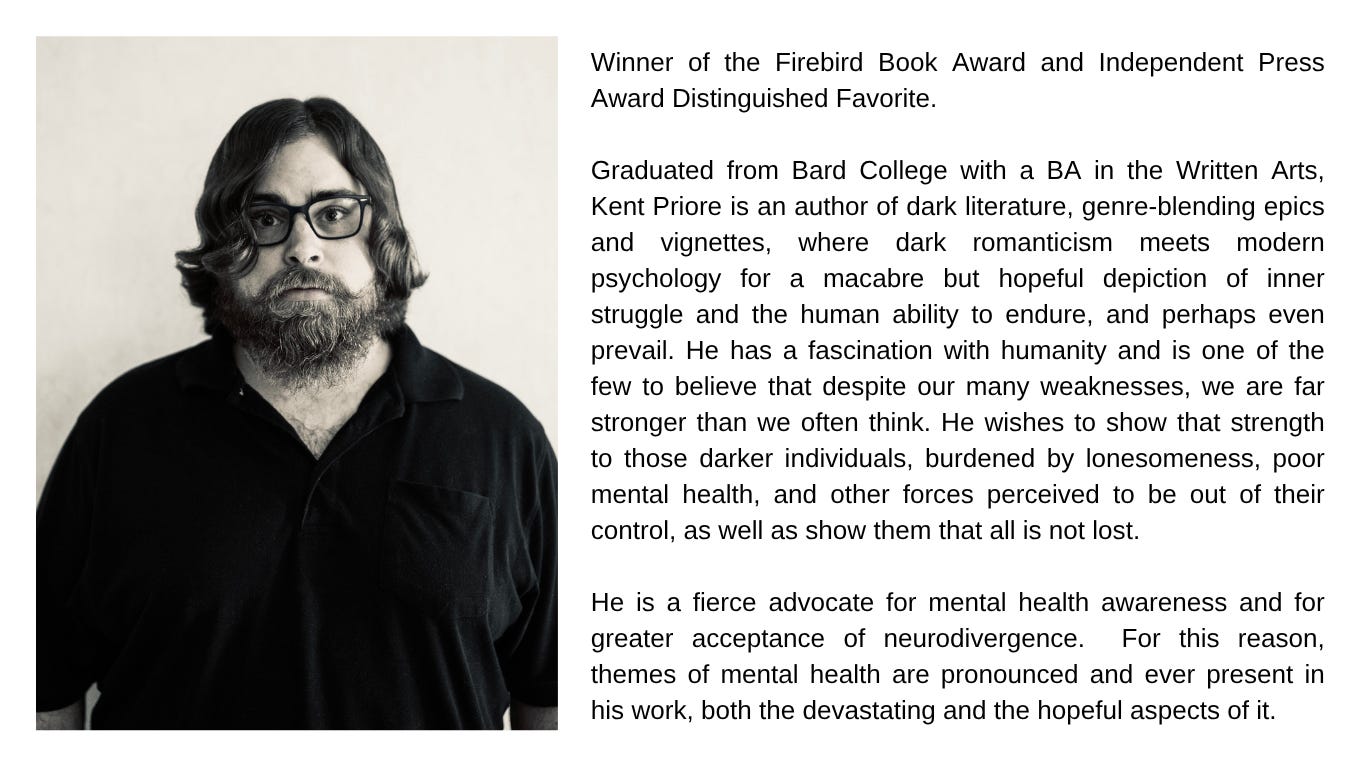
I am an author of dark literature. That could mean horror or dark fantasy as it does in regards to my debut novel, THE MONSTERS AMONG US, but I write more than that, too; sci-fi, memoir, poetry, general fiction, anything as long as its dark.
My current projects are the sequels to THE MONSTERS AMONG US, which is a standalone dark fantasy epic packed with neurodivergent characters and a plot which empowers the neurodivergent and flips the common mental health narrative on its head. What the world sees as illness, brokenness, disorder, I see as a unique and extraordinary gift, a struggle which ultimately leads to great, bright heights, if one can shoulder the burden and find their way through the murky darkness. After all, there are countless great names throughout history that suffered from mental health concerns (I refuse to use the more common term, because I do not agree that neurodivergence equates to illness), such as Hemingway, Poe, Plath. We study the works of these geniuses in college for a reason, and their brilliance had a common denominator; they suffered from depression. And yet, much of our world still views depression, anxiety, bipolar, etc., as inherently bad things. Yes, the aforementioned geniuses either killed themselves or died mysteriously in the case of Poe, but I wrote THE MONSTERS AMONG US because I wanted to explore a possibility; what if we lived in a world which did not view mental health concerns as inherently bad, but as what they truly are; a struggle which arrives in tandem with brilliance and artful gifts. What if society nurtured the neurodivergent, made them feel comfortable and welcomed and loved for what they suffer with? As someone who was bullied and hated and feared when growing up with bipolar, I sure would have liked someone to give me a big, warm hug and say “It’s hard for now, but you are not broken. You are gifted.” That would have made life much easier, and that is the essence of THE MONSTERS AMONG US’s main character’s plight. He, like me, was bullied and taught that he was monstrous for being who he was. Thus placing him on a chaotic, ruinous trajectory. He becomes a monster, because he was told he was a monster. But what if he was supported and care for? To quote that same character when speaking to his daughter in the sequel (for THE MONSTERS AMONG US is a narrative of change and growth, and not purely about the darkness found in mental instability): “So don’t fear the dark. After all, there is no sun without shadow, and it is essential to know the night.”
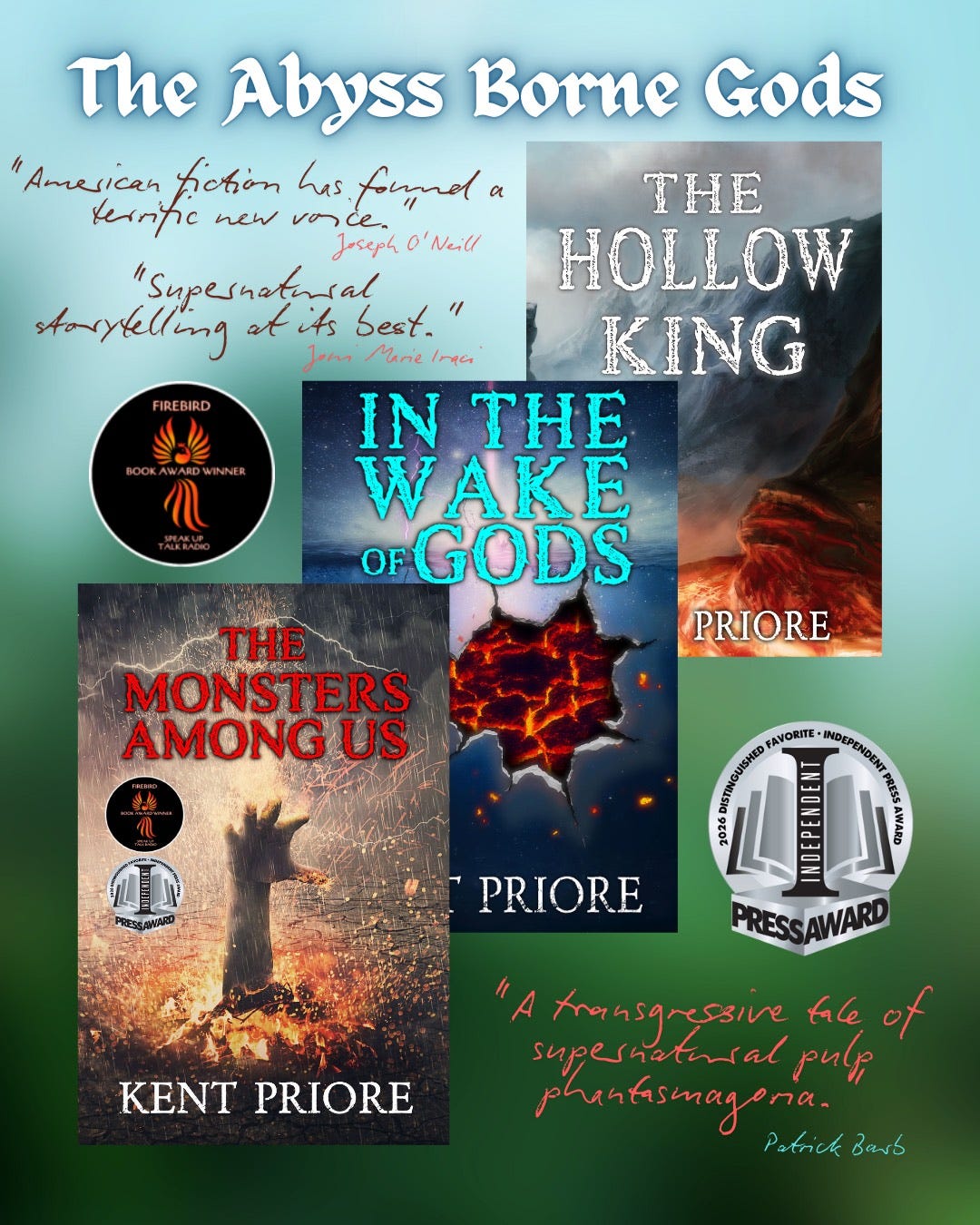
The sequels, IN THE WAKE OF GODS, THE HOLLOW KING, and A LONG BRIGHT DARK expands the already enormous universe found in THE MONSTERS AMONG US, using the foundation of the first book to propel into new and exciting narratives. Much like how the three The Lord of the Rings books exist separate but connected to The Hobbit. Book 2, IN THE WAKE OF GODS releases May 5th, with Book 3, THE HOLLOW KING, releasing in 2027. A LONG BRIGHT DARK, the series’ grand finale, doesn’t yet have a release date because I still have to write it! So that’s the most current project, which I will be starting imminently. I’m quite excited to wrap the series up in big and surprising ways!
2. Where did the inspiration/idea come for this project?
As I briefly mentioned in the previous question, the main character in THE MONSTERS AMONG US, Seth, was bullied and hated, and readers will find that his entire upbringing was the orchestration of malevolent forces, essentially a demonic Truman Show, if you’ve seen the movie. This idea came about because I, too, was hated and prejudiced against for being bipolar. I was bullied in school, I was emotionally abused by family, and my severe Christian upbringing caused great psychological damage I couldn’t sort through and fix until I was in my late 20s. So for Seth’s origin story, my own was used as a mirror. A jumping off point for him breaking free, entering the world of the supernatural and fighting back against the monsters which controlled his life and abused him. All the while fighting also the metaphorical monsters within him.
3. What does the writing process look like for you?
I wake up, I start brewing coffee, I feed and walk the dog. I make breakfast and then immediately get to work. I’m someone who, if I let myself get distracted, I may be deterred for hours and ruin my productivity. So, I am rigid in my schedule, and aim for writing 1500-2000 words a day, Monday through Friday. I usually write from 9-4, and do so in my home library, with my fiancée to my left at her desk, also working from home. Some may think that would get distracting, and it sometimes is, but I’ve gotten so used to is that on the occasion that I try to write elsewhere, another room or perhaps a cafe, I find that the words don’t flow as easily. Plus, it helps when I need a reader’s opinion on an idea. She brings the best out of me in every way.
4. How do you handle writer’s block?
I may come across as full of myself here, but I don’t believe that writer’s block is a thing. Traditionally, writer’s block would include not knowing where to take a story, being depleted of ideas, and not knowing what comes next. I always know what comes next. I’ve never been at a loss for what a character would do. I’ve never not known what the trajectory of their narrative is. I have, however, been simply too tired and burnt out to endure the labor of conveying thoughts into words—but the image, the idea of what needs to happen is always clear in my mind.
So, if someone is dealing with the alleged writer’s block, I’d say take a break. Do something else. You’re burnt out and you need rest.
5. How do you feed your creativity when feeling drained?
As I said above, rest is key. Outside of writing and reading, I also like to play video games. So during time off from writing, I am usually unwinding with a game. I also find walking and hiking to be abundant fuel for creativity. Cardio works exceptionally well in generating idea, all that blood pumping into the brain and all. But cardio out in nature, hiking up a mountain and soaking up its sublime splendor? If a writer is feeling drained, nothing is better than that.
6. What advice would you give writers who feel stuck or uninspired?
I fear I don’t have any unique advice for this. Above I said hiking is a suburb way to get the ideas flowing. But reading as much as one can is the tried and true way training your mind. But don’t just read anything. Read hard books, and practice close reading skills. Analyze the text as you go. Really think critically about what it is you’re reading. You do that, and you’ll train your brain to not only write well, but you’ll also place it in a state that generates ideas spontaneously.
7. Have you ever thought about giving up writing? If so, what pulled you back?
Yes, actually. When querying my debut novel, THE MONSTERS AMONG US, I was rejected over 300 times across two years. I was getting nowhere, and I was disheartened to say the least. I vented to my fiancée—who was my girlfriend at time, and freshly so—about being fed up with the querying process, and I was considering shelving the book and giving up. And I spent six years writing the book, and out of all my work, I love this book the most. So I didn’t arrive to that choice lightly. I was in anguish over the process and couldn’t take anymore.
But my fiancée told me to not give up, saying “someone will say yes eventually,” and she made me feel better about it all. So I didn’t give up. Two weeks later, on Valentine’s Day no less, I signed the publishing contract. Hefty evidence for the existence of fate, even if I don’t believe it.
8.How do you keep your voice or ideas fresh over time?
I have a natural compulsion to be inventive. I typically write in a new genre with each book, never sticking around in one place for long. And while my series is technically an exception to that, each book very much has its own identity and feeling due to that compulsion to seek out unexplored ideas. Which also happens on the fly, while actively writing. An ideas come along and I always make a mental check of them as they do, asking myself, has this been done before? is this too standard, too obvious a trajectory. If yes, then I veer starkly away until I find new and unventured path.
9. What do you wish more people understood about the creative process?
It’s important to realize how laborious writing a novel is. Prepare to write and rewrite a thousand times, and edit a thousand more. A bit of hyperbole, but the vibe sticks. I wrote The Monsters Among Us twice—its first draft thrusted into the abyss, never to return—and it was edited collectively about 18 times. That might seem excessive to some, but I was determined to comb through it and make it perfect. A goal any author who wants to create something truly great should strive for.
10. What is the most honest thing you’ve ever written - and did it scare you?
The most honest thing I’ve ever written is something that readers unfortunately cannot read, and not because it scares me but because it simply hasn’t been picked up for publication yet.
I wrote a creative nonfiction memoir called The Plague Journal, which allows for a voyeuristic view into the mind of someone with bipolar disorder who was also actively struggling. The book being a memoir, that someone naturally was me. The book pulls no punches with how vulnerable I display myself, and all for a good cause. To help others like me feel less alone, feel seen and understood. It’s a book that tackles themes of isolation, lonesomeness, loss and trauma. And it’s a special book, one of my favorites I’ve written. I’m hoping it gets picked up soon so everyone can read it. The notion of which doesn’t scare me at all, as readers of The Monsters Among Us can attest to, it is a trait of my writing to convey neurodivergence in all its unadorned brutality and beauty. I want readers to understand that life, and I guide them through it with unvarnished sincerity.
Where can my audience find you and your work?
Readers can learn all about my work at my website: https://www.kentpriore.com/
Direct links:
They can also find me on social media everywhere: