

1. Tell us about yourself and your most current project/s?
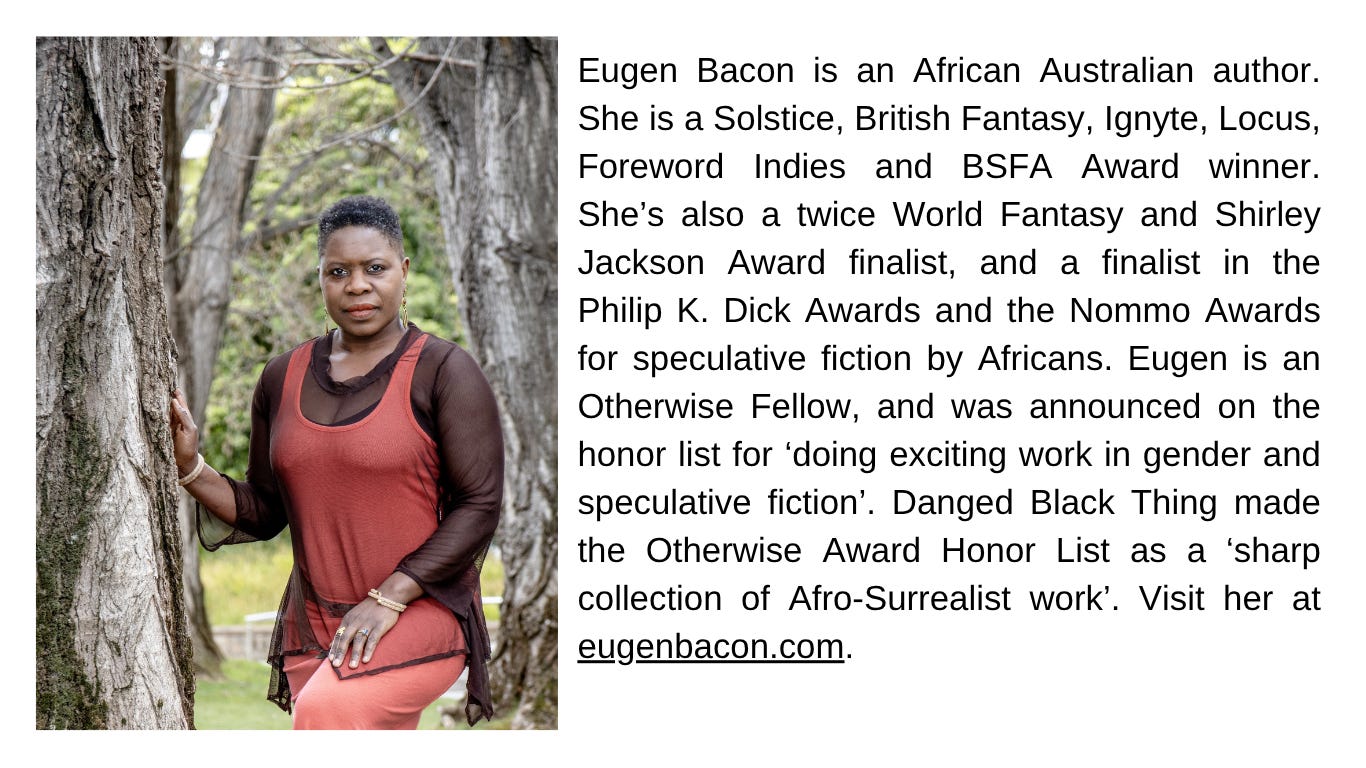
I am an African Australian author and editor of award-winning literary speculative fiction and non-fiction. My latest project Crimson in Quietus is an inaugural novel set in the Afrocentric Sauútiverse—deeply rooted in African mythology, language and culture.
I also have a novella, The Nga’phandileh Whisperer: A Sauútiverse Novella, set in the same universe—it recently won the Foreword Indies Award winning gold medal for Multicultural fiction and was a finalist in the Fantasy category. It’s also a British Fantasy Award finalist.
2. Where did the inspiration/idea come for this project?
Well… I’d written a few stories set in the Sauútiverse, counting ‘The Mystery of the Vanishing Echoes’, a multiverse Sherlock Holmes story where Shaalok Ho-ohmsi is a woman and Wa’watison is her child ward. Together, they solve the mystery of the vanishing echoes on planet Ekwukwe in the Sauútiverse.
Sound magic is integral to our Afrocentric universe and I wanted to explore a longer piece involving sound and silence. Crimson in Quietus is a novel that comprises stories-within-a-story, and charts the paths of Muso’mi, Fin’Lei and serial killer, T. The setting also borrows from Tasmania’s natural beauty of rocky outcrops, stalactite and stalagmite caves, cascading waterfalls, rivulet trails and fiery auroras. What started as an experiment fleshed out into a full-blown novel set in the Sauútiverse.
3. What does the writing process look like for you?
I grew up in a rich culture of storytelling. The African tradition of oral storytelling, riddles, proverbs, song and dance cultivated my penchant for narration. I understood, from a very early age, that sometimes I needed to write it down to understand what I was feeling, thinking, curious about.
The creative space where I tell stories is literary speculative fiction: I write short stories, novels, novellas, prose poetry, creative nonfiction, and across genres.
I am an experimental writer, where text is a curiosity. But I deeply research a novel and structure it into parts—Crimson in Quietus is character-driven, with focus on character arcs.
4. How do you handle writer’s block?
As humans, we cultivate unique responses to trauma. In today’s broken world of normalised greed, hate, intolerance, social injustice, depraved leadership and worse, it’s easy to fall into despair. Writing, for me, has always been a cathartic way for dealing with troubling issues. But, sometimes, the mind and body are just… so… tired. When my creative muse gnarls, I re-learn to be patient with myself. A story will come when it’s ready.
5. What advice would you give writers who feel stuck or uninspired?
Be patient with yourself. You’ll know when a story wants to come out. Nothing you can do will hold it back. In the meantime, do things—like reading a beloved book or watching a movie you adore—that creatively stimulate you.
6. Have you ever thought about giving up writing? If so, what pulled you back?
The closest I came to giving up was when I had an unpleasant experience with a literary agent who didn’t get me, and I was this close to despair. Abandoning that relationship was one of the best things I’ve done for myself. I snatched my dignity back.
7. How do you keep your voice or ideas fresh over time?
It’s terrifying to think that we’re competing with cliched ideas floating around in an age of AI. Authentic writers must, continually, stay ahead by focusing on our human-interest stories with sentient characters and nuances of the human condition that those machine stories might not get.
8. What is the most honest thing you’ve ever written - and did it scare you?
I am continually experimenting with queer protagonists in my writing, as I’ve done in Crimson in Quietus, The Nga’phandileh Whisperer: A Sauútiverse Novella. Another of my books, Serengotti—a literary mystery—has an open gendered character Ch’anzu, who goes by the pronouns zie/hir. Culturally, this is a big leap, and it does scare me.
Where can my audience find you and your work?
I have a new release this October—Black Dingo (short stories) by Flame Tree Publishing. The literary strange unravels in these genre-bending Afro-irreal tales of longing and belonging, unlimited futures, a collision of worlds and everything in between: rich hues of shadow and light.
You can find more of my work at eugenbacon.com.

