

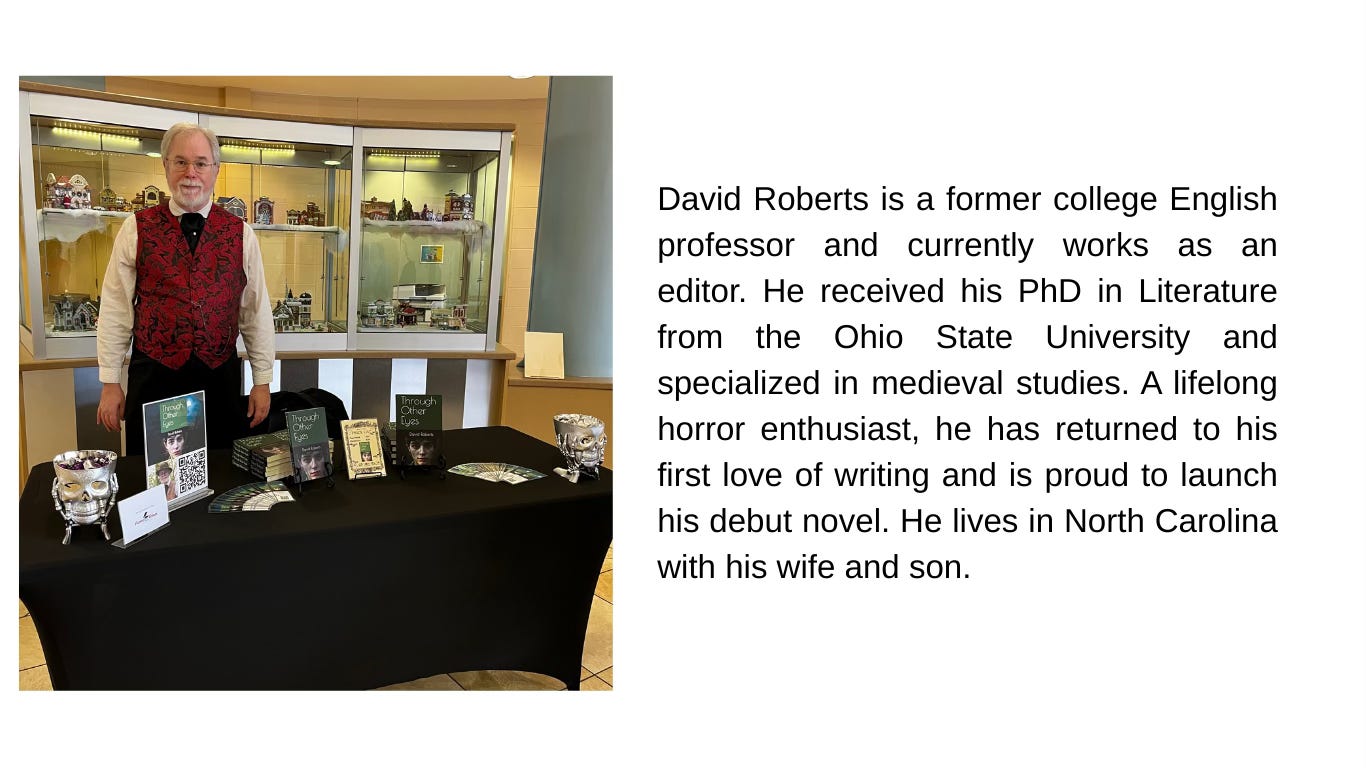
1. Tell us about yourself and your most current project/s?
I am former college English professor and currently work as an editor. A lifelong Horror enthusiast, I have returned to my first love of writing. I live in North Carolina with my wife and son. I published my debut novel, Through Other Eyes, on September 22 of 2025. I am currently working on a follow up novel and have reached about the half way point. I have also just completed a short story, which I hope to find a home for shortly. Finally, I have put together an outline and prologue chapter where Sheriff Ryan, from my first novel, will be getting her own standalone story.
2. Where did the inspiration/idea come for this project?
Through Other Eyes was a story that had been percolating for many years. I first made some rough notes about a decade ago, but never really had the time to persue developing them. [Spoiler Alert] I have felt for a long time that werewolves were the neglected children of the horror genre and that they never got the love and attention that vampires did. Often, they seemed to be relegated to the supporting cast and left wallowing in cliches. I wanted to write a character driven story with a werewolf protagonist who the reader could become invested in. I also wanted to work against some of what I saw as overused tropes in recent werewolf stories. So, as I mulled over this story from time to time over the years, it slowly evolved into a pretty clear vision of how I wanted to redefine the werewolf as a horror protagonist. And I’ll add, I couldn’t be happier with how it turned out and how the story is continuing to develop in book 2.
3. What does the writing process look like for you?
Now that I have fully reinvested in writing, the process for me could almost be described as periods of torrential production interspaced by a week or two of downtime. I try to write, at least a little, every day; and when I don’t write, I try to at least do some editing on what I have written. When I am charged with ideas, when I am on kind of a writing rush, I can turn out eight or ten single space, 10 point font pages a day. When I am feeling stuck or drained, that may dwindle to one page. One of the ways I disconect my mind from thinking about the mechanics of completing a story is to write in single space 10 point font--to trick my brain into shutting up the part that keeps worrying about how much I’m actually writing. I know that whatever the page count is on the screen is not accuate, so that helps me think about the story and not whether or not I’m getting the words I need for a novel length manuscript. Anyway, that’s just a little trick that seems to work for me. There’s nothing better than when I put the font back to 12 point and double space everything and realize I’ve actually written 150 pages and am a lot closer to wrapping things up than I thought. I shift from worrying about how to fill the remaining pages to thinking about what to cut to make the story tighter.
I usually begin stories with an outline. I like to know, roughly, where the story is going and where I need to hit key pacing milestones. But it is not at all unusual for the finished product to not look exactly like the outline. The outline is a starting point, and I always feel very free to just let the story play out in whatever direction it seems to want to go in. I’ll then look at what I’ve got and figure out how to nudge what’s there in the direction of the general plot I’ve worked out. I also tend to be a visual wiriter. I see the story in my head like it is a movie and I just try to report/describe what I’m seeing. When I’m sitting back at the keyboard with my eyes closed, I’m not sleeping--I’m watching a movie in my head. Those are the times the writing is going particularly well. When I’m drained or stuck, I let myself be o.k. with taking a break and will sometimes go a week or two not producing anything--but I know that during that time, some part of my brain is working on it, and when I do get back to actually writing, it will be good.
4. How do you handle writer’s block?
I usually handle writer’s block either one of two ways. For “little” writer’s block, I force myself to write something--anything, even if it is horrible. Just the act of writing will jostle free the little blocks and you can scrap the stuff you did just to get started and get back to the good stuff. I also try to have more than one thing going at a time. That way, if I’m blocked on the novel I’m working on, I might just spend the day writing a short story, or doing an outline for another novel idea I may have. That way, the writing is new and different and I can work through the block with that writing and then go back to my main project when I’m ready.
For “big” blocks, I tend to shut down for a few weeks. I think its important for writers to learn to be o.k. with shutdowns. They are an important part of the creative process where whatever it is that fuels us, recharges. Listen to your rhythms and enjoy your time to goof-off. I usually binge play video games when I should be writing. I’ve learned that by letting your consious mind play hooky, you are probably letting your subconscious recharge its idea pool. I always come back from those off times to several days of really heavy production.
5. How do you feed your creativity when feeling drained?
I like to cook. I’m also into cowboy action shooting and casting my own bullets. I’m trying to teach myself leather work. I think that doing a different creative activity can help you recharge your batteries when your creativitiy is drained in other areas. I also think binge playing video games or binge watching horror movies is also a great way to recharge.
6. What advice would you give writers who feel stuck or uninspired?
The advice would depend on the nature of being stuck or uninspired. Sometimes its writing through it and sometimes its taking a break. Only you know what you need, and you need to listen to your inner voice. Most importantly, though, is not to get stuck in your own head. I got stuck once because I didn’t know how to realistically solve a problem for my protagonist. It got to be a spiral where I felt each solution was worse than the last one, and I got really frustrated and was stuck for probably a month or so. I got in my head and was really down on myself because I couldn’t figure it out, and I couldn’t research my way out of it. I felt like I was falling farther and farther behind, and I was furious with myself that my writing had ground to a halt over such a little thing. Now what I should have done, was just stop being linear and write a different section of the story--but I got so fixated on the narrative problem that I couldn’t see that. Finally, after going through several weeks of pretending that my writing didn’t exist and going through that down time phase, I was able to get out of my own head and I realized I didn’t need to solve it--that’s how two sentences about another character who did know what to do, fixed the problem. I still don’t know exactly how that character aided my protagonist--but that’s the point--I didn’t need to, I could just report that they did. It got the action moving again and I couldn’t see that while I was stuck in my own head trying to work it out.
7. Have you ever thought about giving up writing? If so, what pulled you back?
Giving up--no, but I have had an extended absence. I wanted to be a writer since my early teens and I remember having stories typed up and sending them off to magazines, hoping to be published. This was the early 80’s. I never got anything published, but I did get some nice responses where editors gave me feedback and advice. I decided that I should teach college while I wrote so that I could support myself until I was able to make a living off of my writing--ah, the naivete of youth. Going into academia is a full time career. Once I got to college, my writing ground to a halt, and before I knew it, the only writing I did was non-fiction, academic stuff and my pursuit of degrees and then teaching jobs left no room at all for my writing. The desire was still there, and ideas for stories abounded--but life was too crowded to work on them in any serious way.
Then I switched careers and became an editor (editing business documents for a company) and initially I traveled a bit, leaving me away from my family and stuck in hotel rooms for a week at a time. I started writing again. Eventually, the traveling stopped and I transitioned into remote work, and that freed up a lot of time to continue my writing. The more I wrote, the more I found that I was at a place in life where I could really dedicate some time to my writing and it has been wonderful. I am also at a point in life where I realize that it is the experiences I have had that make me the kind of writer I could never have been had I been able to plug away at it when I was younger. I have no doubt that I write better stories now than I could have written then.
8. How do you keep your voice or ideas fresh over time?
I don’t know the answer to that one. I’ve only just got my debut novel out, so I haven’t had to worry about keeping my voice and ideas fresh over time. Honestly, I think I’ve banked enough ideas over the years that I am finally able to return to, it should be a while before I have to come up with a strategy for keeping my voice fresh.
9. What do you wish more people understood about the creative process?
That it is unique. I don’t believe any two people experience the creative process in the same way. It is the most un-uniform, messy thing out there and only really works when it is completely individualized. I can remember taking a creative writing class and there was a lot of focus on prewriting and clustering ideas and engaging in creative exercises. I am sure there are people out there who may find that useful. I do not. To have it forced on me did nothing but strangle my creative process. You have to find what works for you and have the resolve not to listen to all the people who “know better.” They don’t. The idea that you can somehow codify the process and transmit it to others by rote is nonsense. When I taught, I always told my students to take that stuff as suggestions and to feel free to discard any or all of it. You have to discover your own creative process.
10. What is the most honest thing you’ve ever written - and did it scare you?
I would say the most honest thing I’ve ever written are academic papers, and that never scared me. In academic writing, I always proceeded from a place of confidence because I had answered the question I was writing about for myself. I was confident I was correct, and my audience could either be convinced or not, but I had already moved on. Fiction is much scarier--aside from the fact I write in the horror genre. With my fiction, I really care what the audience thinks. I think we all know, insitictively, that our writing will not please everyone’s tastes, and I’m o.k. with that. But in general, I want my audience to like the stories I want to tell--so putting that stuff out there can be a little scary.
Where can my audience find you?
Book link:
Facebook author page: