

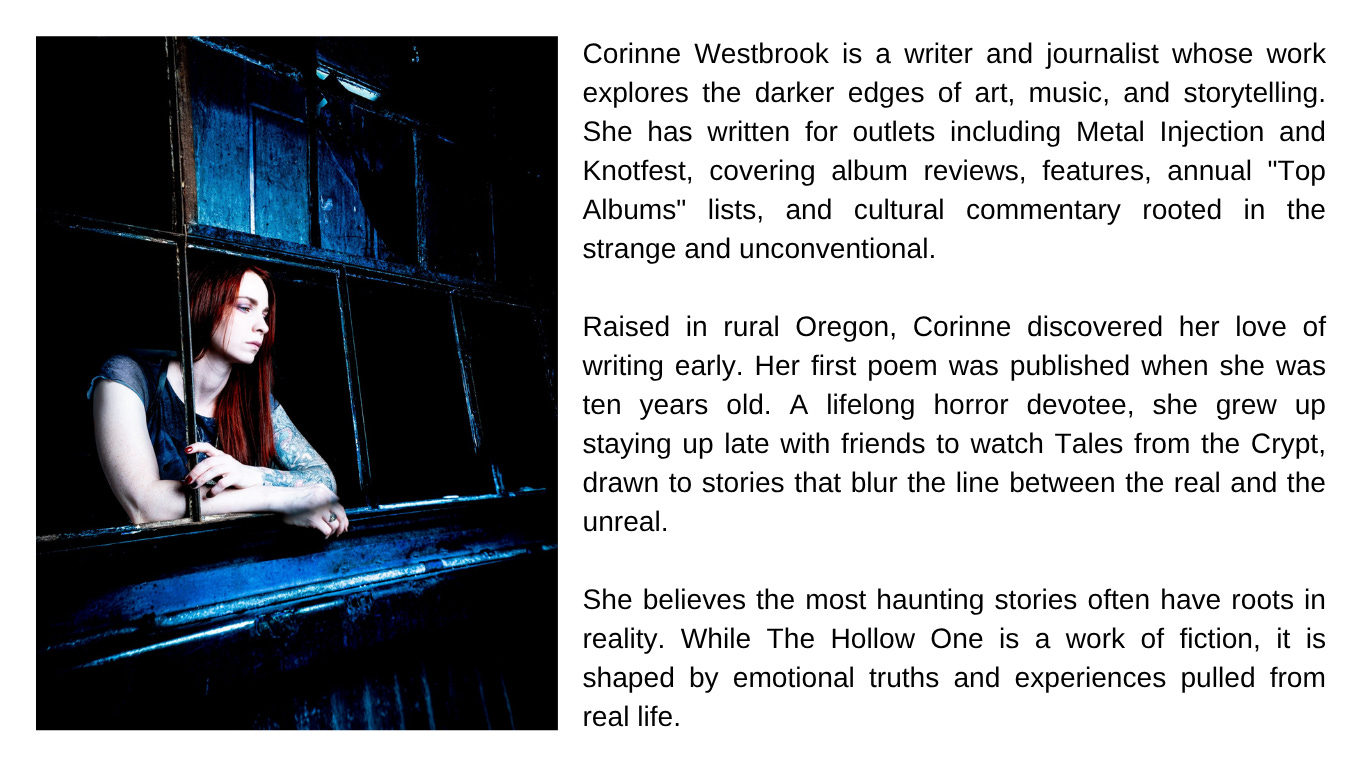
1. Tell us about yourself and your most current project/s?
I’m an author, journalist, lifelong horror fan, and music obsessive. I’ve spent a lot of my life writing about the things I love, especially horror and heavy music, and now I’m incredibly excited to have my debut novel, The Hollow One, out in the world.
The Hollow One is a psychological horror novel about grief, childhood trauma, family secrets, and the frightening things that can slip into the spaces where love and safety should have been. It’s dark, emotional, and very close to my heart.
2. Where did the inspiration/idea come for this project?
The Hollow One came from a very personal place. I grew up around addiction and instability, so a lot of the fear in the book started with real emotions before it ever became supernatural horror.
The first spark was a childhood memory of my father coming home after a fight with my mother about his drug use. He stood outside my bedroom window, throwing pebbles to wake me up so I would let him back into the house. I remember looking at him and feeling, maybe for the first time, that something about him felt wrong. He was still my father, but in that moment he also felt unfamiliar and frightening.
That feeling stayed with me for years. Not just the image of someone at the window, but the confusion of loving someone and being afraid of them at the same time. That became the heart of The Hollow One. I wanted the horror to feel intimate, like something that creeps into your home, your family, and your mind.
The supernatural part of the story gave me a way to explore feelings that are hard to explain when you’re a child: neglect, fear, isolation, and wanting so badly to be seen or chosen. For Ellie, the monster is terrifying, but so is the reality she’s already living in. That was always the real emotional center of the book. The entity became a mirror for what she was experiencing inside.
3. What does the writing process look like for you?
For me, writing usually starts with a feeling or an image I can’t shake. I don’t always know the whole story right away. I’ll have a moment, a mood, or a question, and I follow it until it starts becoming something bigger.
With The Hollow One, I kept coming back to the image of a child at a window and someone outside asking to be let in. From there, I built the story around fear, grief, loneliness, and the complicated ways families can hurt each other. I tend to write in layers. First I get the story down, then I go back and deepen the emotion, the atmosphere, and the dread.
4. How do you handle writer’s block?
I try not to panic when it happens, although that is definitely easier said than done. Usually writer’s block means I’m tired, overthinking, or trying to force the story in the wrong direction.
Sometimes I step away and give my brain a break. I’ll listen to music, watch a movie, read, go for a walk, or just let myself be quiet for a bit.
5. How do you feed your creativity when feeling drained?
Music is a huge one for me. I’m really inspired by mood and atmosphere, so listening to the right song can unlock something emotionally for me. Horror movies, books, art, and even old memories all feed into it too.
But I also think rest is part of creativity. Sometimes the best thing I can do is stop trying to produce and let myself just be a person for a while. Creativity needs room to breathe.
6. What advice would you give writers who feel stuck or uninspired?
Go back to what made you want to write in the first place. Read something that excites you. Watch something that scares you. Listen to music that makes you feel something. And don’t worry so much about making it perfect. The first draft is just you telling yourself the story.
7. Have you ever thought about giving up writing? If so, what pulled you back?
Yes, absolutely. I think a lot of writers have those moments, especially when the process feels lonely or when you start questioning whether anyone will care about what you’re making.
What pulls me back is that writing is how I process the world. Even when I try to step away, stories still find me. A character, an image, or a line will pop into my head, and eventually I realize I’m not done. I don’t think I really know how to stop being a writer.
8. How do you keep your voice or ideas fresh over time?
I try to stay honest. What scares me now isn’t always the same thing that scared me five or ten years ago, so I let my work grow with me. I also try to stay curious and open to different influences.
For me, horror is most interesting when it comes from something real: grief, guilt, loneliness, family, love, fear, memory. As long as I’m paying attention to the things that feel emotionally true, the ideas keep changing and growing.
9. What do you wish more people understood about the creative process?
That it’s not always pretty. Sometimes it feels magical, but a lot of the time it’s messy, frustrating, and full of doubt. You can love writing and still struggle with it. You can be grateful for the work and still have days where it feels impossible.
I wish more people understood that creativity takes time, patience, and a lot of vulnerability. The finished book is only the visible part. There’s so much fear, hope, revision, and second-guessing underneath it.
10. What is the most honest thing you’ve ever written - and did it scare you?
The Hollow One is probably the most honest thing I’ve written so far. The horror in it is supernatural, but the emotions underneath are very real: grief, neglect, fear, longing, and the way childhood can shape you long after you’ve left it behind.
It did scare me to write it. Not because of the monster, but because of the human parts. Those were the pieces that felt the most vulnerable. But I also think that’s why the story mattered so much to me.
Where can my audience find you and your work?
You can find my debut novel, The Hollow One, wherever books are sold. You can also find me at corinnewestbrook.com and on Instagram at @corinnewestbrook.

