

1. Tell us about yourself and your most current project/s?
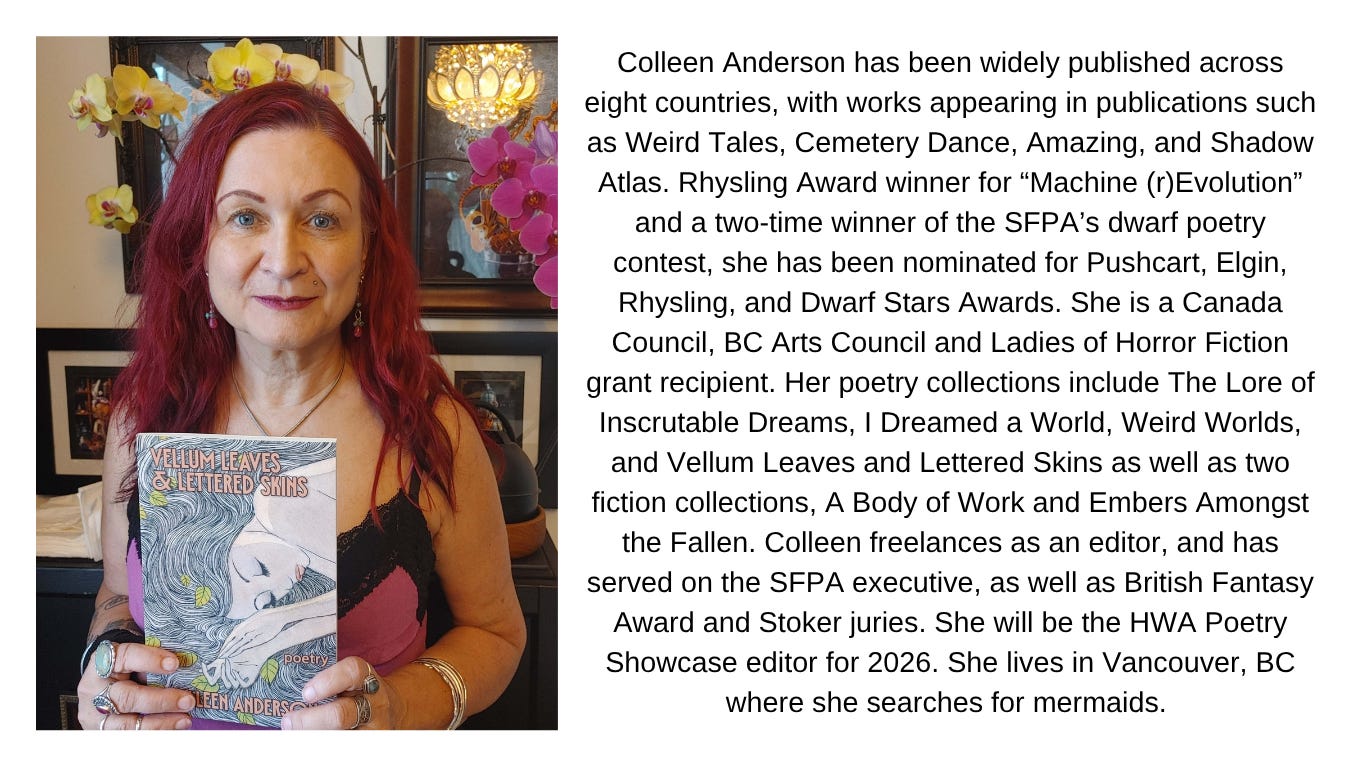
I write anything that grabs me but usually that’s something speculative and dark, whether it’s prose or poetry. My poetry collection, Vellum Leaves and Lettered Skins, a retelling of Rapunzel beyond the fairy tale, came out in 2025, and To the Last Ion, a collection of SF horror poetry will be coming out in the fall of 2026. A mosaic novella, Awaking Pandora, consisting of weird eco horror is due in 2027. Other projects include a collection of short fiction, a short collection of food related spec poems, and possible a poetry collaboration. I’m working on a novel as well, so there are lots of irons in the fire.
2. Where did the inspiration/idea come for this project?
After writing Vellum Leaves and Lettered Skins, steeped heavily in fairy tale, I needed to balance my poetry brain. I was a little sucked dry so what is the opposite of historical (ish) fantasy? SF body horror. I started writing poems that examine different ways aliens might look at us, or how we might reshape ourselves in the future. There is a fair amount of social commentary in this collection, whereas Vellum Leaves looked at the effects of isolation and depression. Awaking Pandora came from a story that looked at a future so infected with toxic land and pollution that people are living on garbage barges and farming them.
The story went through many rewrites and shifts; then because I wanted to write a novel without writing a novel, I started to write stories in this same world, from different people’s points of view. In that time frame of writing the stories, my mother and brother died within a year of each other. I didn’t realize at first that each of my characters was dealing with a death, so in a way I was working through my own grief by writing these tales. Eco horror, because we’re living in a world that humanity is cannibalizing, is something I’ve been exploring for awhile and am very concerned about. This features in each story, as well as referencing a Greek myth.
3. What does the writing process look like for you?
It’s a process of fits and spurts. I often ruminate an idea first, whether poem or prose. Especially for poetry, I will write out a few drafts by hand, or list questions and points for a story. I might get into an obsessive stage and pound out a lot at once. Or it will be long and arduous where the words don’t want to come. I often have to coax, cajole or threaten the muse to perform.
Once I have the basic content down, I rewrite. This sometimes means stepping away for a few days or weeks (unless there’s a tight deadline) and coming back to it with fresh eyes. I’ll start trimming extraneous words--too many adjectives or adverbs--as well as searching for expository phrases and reworking. By the time I’m done, I’ve usually done at least 3-4 passes on a new piece. This also doesn’t count the research that happens along the way. Depending on what I’m writing, this could be a little or a lot, with dangerous pitfalls of getting sidetracked into minutia. Sometimes I plot and sometimes I don’t
.
4. How do you handle writer’s block?
I use writing prompts. Various magazines often have a monthly challenge or a drabble contest. Writing those can get the juices flowing. Once in awhile I’ll post a question through facebook and see what ideas people throw out. These are rarely plots but more setting that might inspire me.
Watching shows or movies, reading other works, and just asking myself, what if this happened, can unlock writer’s block. Also anthologies with themes are a good way to spur creativity. It doesn’t always work though or sometimes the idea comes too late to submit to an anthology.
With poetry, I’ll sometimes try poetic forms. This requires more discipline in not just the form but a suitable subject to write about. I’m rarely ever stuck with nothing to write. And then, I have a file with half formed ideas or phrases that I can pull from as well.
5. How do you feed your creativity when feeling drained?
Ruminating through power naps. I also almost always carry a blank book and will write observations, lines that pop into my head, anything. And of course, going for walks, just chatting with friends. Often just talking about life and events can inspire new ideas. Breaks with physical exercise really help regenerate creativity. I also do bellydance, or make jewelery and I might start trying some drawing again.
6. What advice would you give writers who feel stuck or uninspired?
Talk with other writers, do stream of consciousness writing, read something, watch movies and ask yourself what you like about them. I’m often inspired by other writers or artists. Write an ekphrastic piece based on an existing work of art. Think of an idea and then see how far you can twist it.
7. Have you ever thought about giving up writing? If so, what pulled you back?
I have and it’s probably common for enough writers. I gave up once, for a couple of years but I felt like I’d lost a limb. There was a hollow that couldn’t be filled. I have to write, even if it doesn’t always make me happy. I equate writing to an addiction; it’s not always fun but I have to do it to stay somewhat sane. It’s like breathing or eating to me.
8. How do you keep your voice or ideas fresh over time?
That’s a good question and probably the hardest to answer. It’s maybe the hardest to do. As mentioned above, I switched from poems in a fairy tale world to SF body horror. That’s one way of doing it; flip from the familiar. Some of my other techniques, such as asking people to throw out ideas, no matter how dumb or overdone, is a great way as well. And then reading other works. I’m envious of other people’s minds but they also inspire me to reach far beyond the comfort zone.
9. What do you wish more people understood about the creative process?
It’s not instantaneous. In speculative fiction and poetry, there is often world building that doesn’t go into the story, but the structure of the created world has to work. It can involve figuring out why that particular science, magic or horror exists, how it functions and what happens if this or that comes along. The same goes for characters. What’s their backstory and how does it affect their decisions? Much of this doesn’t end up in the piece but is part of the work for making the tale complete.
And then there is revision and rewriting. Killing your darlings must sometime be done, whether it’s a character, a setting, or a phrase.
10. What is the most honest thing you’ve ever written - and did it scare you?
I think there is some truth in many things I write. Is that the same as the most honest? I really don’t know. We often do use our experiences and acquaintances in our writing but not all the time. As a speculative writer, I also imaging what-ifs or examining types of personalities or events. So, most honest.
I’m really not sure. I wrote a story called Consuming Fear. It looks at a girl who is sexually abused and a black hole develops in her stomach. Having been sexually abused, I did reach into some of my feelings and dealing with an eating disorder as a result.
Where can my audience find you and your work?
My books are listed on Amazon, and of course they’re on the publisher websites as well as with me in Vancouver.
Goodreads list many books in which some of my work is included.


