
Christa Carman
I’ve been tying the dog’s leash around my waist, taking a notebook and pen with me and writing while we walk

1. Tell us about yourself and your most current project/s?
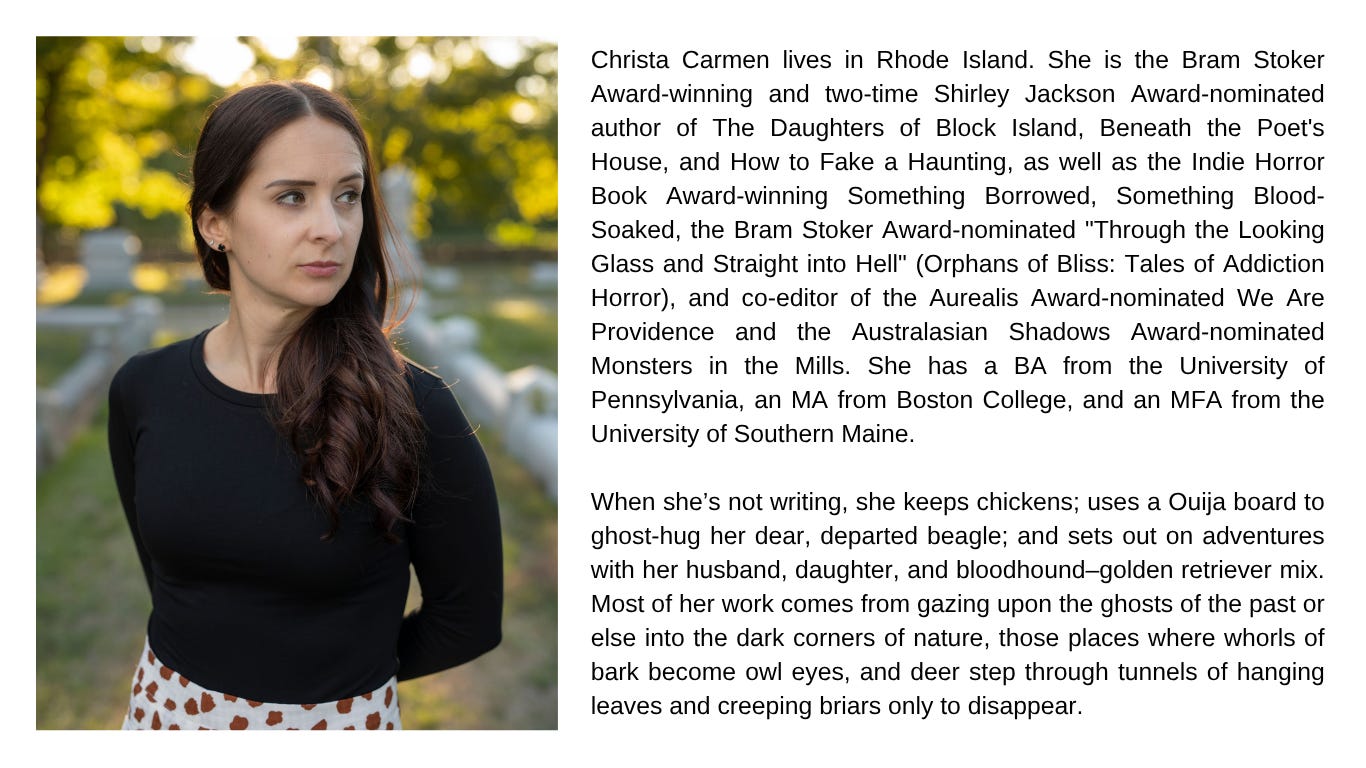
I live in Rhode Island and am the author of How to Fake a Haunting, Beneath the Poet’s House and The Daughters of Block Island, which won the Bram Stoker Awards® for Superior Achievement in a First Novel and was a Shirley Jackson Award finalist, as well as the Indie Horror Book Award-winning Something Borrowed, Something Blood-Soaked, and the Bram Stoker Award-nominated “Through the Looking Glass and Straight into Hell” (Orphans of Bliss: Tales of Addiction Horror). I have a BA from the University of Pennsylvania, an MA from Boston College, and an MFA from the University of Southern Maine.
In May of 2014, I was on a train back from Baltimore to my hometown in Rhode Island after a family gathering, and I ended up downloading Stephen King’s On Writing: A Memoir of the Craft to read on my Kindle. I had read the book before, but I’d recently overcome a fair amount of upheaval in my life and was reconnecting with things that brought me joy. As I read, I remembered, almost like a woman awakening from a bad dream, that not only did I love reading, but I loved writing, and there was nothing stopping me from doing just that. I’d written a lot in the past—mostly journaling and some weak attempts at novels and a memoir—but never with the express intent of trying to get published. By the time the train arrived in Westerly, I was outfitted with a plan and no small amount of inspiration, maybe even preoccupation bordering on obsession. By the next day, I was trying my hand at short stories, and by the end of that summer, I’d finished a draft of my first novel.
My most current project, How to Fake a Haunting, came on the heels of two other novels set in Rhode Island. The Daughters of Block Island takes place at White Hall on Block Island, and Beneath the Poet’s House is set at 88 Benefit Street in Providence, which was the home of Sarah Helen Whitman, onetime fiancé of Edgar Allan Poe. The events of both these novels are unable to be divorced from their settings, but with How to Fake a Haunting, I had set out to tell a story that felt like the inverse of “setting influencing narrative” (the question I’d asked myself was, what if wasn’t the past or bad bones that caused a house to be haunted but bad guts, what it consumed, what lived within it… inhabitants that were parasites of sorts, transforming the constitution of their host?).
2. Where did the inspiration/idea come for this project?
There was a very specific moment of inception for How to Fake a Haunting. My husband and I have been married for nine years this past October, and like many couples (or maybe just many people once they reach a certain age), we tend to occasionally (ahem, often) spend so much time choosing a movie to watch, that by the time we turn it on, one or both of us falls asleep. On this particular evening, my husband swore he wasn’t tired; we chose a movie, and not five minutes later, he was asleep.
Annoyed, I decided to head in and get ready for bed. But before I could, an idea hit me like a horror movie jump scare. I grabbed his cell phone, and took a picture of him sleeping on the couch. I think maybe I was planning to show him the picture in the morning, like, “I told you you’d be the one to fall asleep!” Instead, I texted the picture to myself, walked into the kitchen, and then stormed back into the living room loud enough to wake him. “Why did you just text me a picture of yourself sleeping?” I asked. Disoriented, he replied, “What? Why would I text you a picture of myself sleeping?” But I doubled down, narrowed my eyes, and said, really cryptically, “You mean, you didn’t just text me this picture of you sleeping from your phone?” Needless to say, he was suitably freaked out, and eventually, I caved and admitted to the prank. When the time came to get working on a new novel, I thought of the playfulness of scaring your spouse, and how the idea of faking a haunting could be really fun, which morphed into questions of why someone would want to commit to a fake haunting, and things took off from there!
3. What does the writing process look like for you?
With a five-year-old daughter, I certainly don’t write at the same time each day; I don’t even write daily. To put it simply, I write when I have an ongoing project I need/want to work on, or if the idea for a new project or short story strikes me. Once I’m working on a project, especially a big one, I’ll get into a routine of hitting a daily page or word count, but I have to take advantage of the time during which I can write whenever it presents itself. That might be for twenty minutes in bed with my daughter while waiting for her to fall asleep or four hours straight on a weekend when my husband is at work and my daughter is with her grandparents or cousins. In a way, it’s a more productive schedule than the one I had before she was born; I can’t waste time picking out ambient coffee shop sounds on YouTube or reheating endless cups of tea or screwing around on the internet. I also have a career in pharmaceuticals, so when I have an hour to write, I HAVE TO WRITE.
I can write first drafts on the computer or by hand, so that’s very helpful. This is a recent development, but I’ve been tying the dog’s leash around my waist, taking a notebook and pen with me (and nothing else), and writing while we walk. It sounds crazy, but it’s a great way to get away from the distractions of cell phones and social media in the house, and it’s a quiet, built-in hour-to-myself I’ve learned to take advantage of!
4. How do you handle writer’s block?
I haven’t ever dealt with writer’s block before, so I haven’t had to come up with any clever or resourceful ways of combating it. I can say that, oftentimes, I struggle with the opposite problem, which is having too many ideas and not enough time in which to write them. Walking my dog or going for a jog are the worst for me in terms of instigating a flood of ideas. I’ve jogged myself into any number of new ideas, and while many of them are fated to languish in my “ideas notebook” (yes, I have to have this, as lame and fifth-grade-nerdy as it sounds, because I have the memory of a gnat specifically when it comes to ideas, and if I don’t jot them down instantly, they flutter away like so many pollinating butterflies), I’ve also nurtured plenty of run-or dog-walk-seedlings into full-blown short stories or even novels.
I guess that I’d imagine the best advice for anyone suffering from writer’s block is not to get too hung up on the perceived inability to produce new work and try to relax as much as possible. I know that’s easier said than done, but like anything in life, the more you worry about something, the more power it tends to have over you. Go for a walk or a museum or simply read new exciting work by authors you admire. By immersing yourself in things you enjoy and other creative pursuits, you’ll likely re-inspire yourself with far more success than if you force yourself to sit in front of the keyboard, sweating, for a designated number of minutes or hours each day.
5. How do you feed your creativity when feeling drained?
I immerse myself in research, legends, ghost stories, and local lore surrounding Rhode Island and the greater New England area!
Six years ago, when I was pregnant with my daughter, my mother reminded me that she and my father had been saving boxes and boxes of books in their basement for when I had my first child. I found the requisite baby books, the chapter book series (Goosebumps, Bunnicula, Baby-Sitters Club, Nancy Drew), but I also found something else of interest: a book of Rhode Island legends and folklore in pristine condition, signed and personalized for me by the author. Flipping further into the book, I found that the first chapter was dedicated to Mercy Brown. For anyone unfamiliar with Mercy Brown, she was the last person exhumed in New England after death in the name of vampirism. Put plainly, she was dug up a few months after her death, and her heart and other organs were examined in hopes of naming her the “offending corpse,” an undead soul that would rise from the grave to drain the life force of others in the community, in this case, her brother, Edwin. Interestingly enough, Mercy Brown was the subject of the novel with which I acquired my lovely agent, and I remain fascinated by her to this day (I guess it’s no surprise I kept that childhood book!).
There are countless other legends and ghost stories of Rhode Island that have interested me enough to write about, including Dolly Cole, in my short story “The Circle,” included in the Shirley Jackson Award-nominated anthology, Monsters in the Mills, and Sarah Helen Whitman (a historical figure, but someone about whom ghost stories abound) in my second novel, Beneath the Poet’s House.
Beyond ghostly figures, I like to dig into place. I think my consistent use of Rhode Island as setting can be attributed to a combination of two factors. First, there is absolutely something haunted and horrific about the smallest state in America. Especially in the beach communities at the southern part of the state, there’s such a sense of isolation in the winter, of things lurking in the cold and waiting to awaken. Additionally, while I don’t necessarily subscribe to the oft-repeated “write what you know” adage, I find that setting a work of fiction in a place with which you are intimately familiar makes for fiction that can be more dynamic to read, and more enjoyable to write.
6. What advice would you give writers who feel stuck or uninspired?
I’ve been asked in other interviews and by other writers and readers about advice for authors feeling stuck, and my suggestion is always to just not stop, even if the work is tough or feels stagnant. Turn all your anger and disappointment and dissatisfaction (and, since I believe we each have a shadow side and a lighter side to our personality, all of your joy, success, and happiness, too!) into stories. Those stories make the world the magical place it is. It’s a real gift to harbor a talent and passion for writing. Embrace it, and share it with others, no matter what obstacles get in your way.
7. Have you ever thought about giving up writing? If so, what pulled you back?
I have not ever thought about giving up writing, not even for one second. I will say, though, that it’s important not to compare yourself to others if you want to stay positive and stay motivated. I recently saw a clip from a podcast where Paul Tremblay mentioned having a conversation with another phenomenal horror writer, John Langan, and that they make it a point to “judge” their present circumstances and current successes against where they were ten years ago, not against other writers’ accomplishments, and I just love that. It’s such a great way to avoid falling into the pitfall of always moving the finish line on yourself. How could I ever lament things I’ve yet to accomplish when I can look back to ten years ago and remember that, at that moment in time, I was just setting up an author website with a single short story acceptance at a nonpaying, online-only ezine when today, I hardly have time to update my website at all with all the wonderful things going on like bookstore appearances, trade publication reviews, and interviews such as this one? Seriously, a little over ten years ago, I had one short story acceptance to my name. That was the extent of my website: a cheeky “Christa Carmen bio” and a single link to my “work.” If you’d told me ten years ago that, in 2025, I’d be celebrating the release of my third novel, I would have fallen on the floor. So, yes, judging against my own past milestones, I feel I am “successful,” and have no desire to give up writing now (I also wrote a Substack piece recently about another reason why I won’t ever give up writing, and any interested readers can find that here: https://christacarmen.substack.com/p/a-few-thoughts-on-ai).
8. How do you keep your voice or ideas fresh over time?
I think it helps to have a goal. And I don’t necessarily mean a goal to, say, complete your first novel in a single month, but any goal, no matter how small, helps keep you on track. Maybe start with something that gets your butt in the chair as consistently as you’re aiming for and work your way up. My writing goals are simple these days: meet deadlines—regardless of what that looks like for word count or days in a row spent writing—and respond to the Muse when she comes knocking.
9. What do you wish more people understood about the creative process?
In my opinion, it’s the creative process that’s easy, and the business side of things that’s tougher to understand and come to terms with. Perseverance is the key to allowing your creativity to flourish over a significant period of time. The first time I queried agents was in 2014 (with a gothic horror novel set in Maine). I kept an old school Excel spreadsheet, found a list of reputable literary agencies on a Writer’s Digest website, and went agency by agency, identifying the agent at each that was the best fit for my work. The manuscript garnered a modest amount of interest, including one request for a rewrite to cut about 15,000 words, but ultimately, I did not end up with any offers for representation. I took this as a sign that the novel wasn’t where it needed to be and trunked it. Then, I went back to work. I wrote two additional novels (that were probably worse than the first) before beginning my MFA at Stonecoast, where I focused primarily on figuring out what kind of novel writer I was. By the end of the two-year program, I had a new manuscript that I was very pleased with, and I returned to my old spreadsheet to see if any of the same agents were looking for new clients (after checking that their wish lists and guidelines remained the same).
I remembered one agent’s profile the second I saw it on the Sandra Dijkstra Literary Agency’s website. Jill Marr’s keen insight, experience within the field, and enthusiasm for her authors and their projects seemed like a great fit for me and my manuscript, and I’m happy to say that I was right. She responded with an enthusiastic, “This is SO RIGHT UP MY ALLEY!” and a request for the full manuscript, and one week later, we were signing the agency agreement, seven years after I’d queried her with my original project. So, for me, it’s far easier to keep the creativity flowing if I remember that the business side of things takes time, patience, and, perhaps most of all, that it sometimes takes a bit of willingness to just sit back and enjoy the ride.
10. What is the most honest thing you’ve ever written - and did it scare you?
One topic that’s been able to worm its way into my heart like a maggot into an apple no matter how much time passes is the horror of substance abuse and addiction, and today, more specifically, the horror of relapse. I explored this fear pretty explicitly in my contribution to Wicked Run Press’s Orphans of Bliss: Tales of Addiction Horror, edited by Mark Matthews.
“Through the Looking Glass and Straight into Hell” doesn’t ask, “What would happen if you relapsed after so much time being clean?” but, “What if everything you think you’ve accomplished since getting clean never happened at all?” It’s probably my most personal story to date, and that it was a Bram Stoker nominee for Superior Achievement in Long Fiction was an absolute dream come true, not so much because it was an honor, which, of course, it was, but because it meant that people had read the story and connected with it on some level, that my fear was perhaps their fear, or at least a fear they’d considered with regards to a friend or a loved one. There’s no greater feat, in my opinion, that a writer can achieve, than having the window they held up for the reader—a window into something that terrifies them personally—turn into a mirror.
Where can my audience find you and your work?
Anyone interested in updates can find me online, at Facebook, Instagram , and Bluesky, as well as on my website, www.christacarmen.com.
You can also catch me, along with cohost Matthew Brockmeyer, on Murder Coaster: A True Crime Podcast, which airs weekly wherever you listen to podcasts.
Finally, you can join my Substack for updates on events and news about my books, as well as recommendations for legend tripping and literary tourism across New England, insight into my creative process (i.e., “What’s a better method to overcome sticky plot points, outlining, or witchcraft?” and “Will my latest WIP treat me gently, or will I end up scribbling on a roll of easel paper with Crayolas at two a.m. in an attempt to visually represent pacing versus character development in some sort of deranged x-y graph?”), and general horror-related commentary, like what books I’m reading or what films I’ve managed to sneak in on Shudder after regaling my daughter with enough spooky bedtime stories to make Alvin Schwartz go cross-eyed.


